customnursingassignments.com has the top and most qualified writers to help with any of your assignments. All you need to do is place an order with us.(Interaction between Nurse Informaticists and Other Specialists)
Nature offers many examples of specialization and collaboration. Ant colonies and bee hives are but two examples of nature’s sophisticated organizations. Each thrives because their members specialize by tasks, divide labor, and collaborate to ensure food, safety, and general well-being of the colony or hive.
Of course, humans don’t fare too badly in this regard either. And healthcare is a great example. As specialists in the collection, access, and application of data, nurse informaticists collaborate with specialists on a regular basis to ensure that appropriate data is available to make decisions and take actions to ensure the general well-being of patients.
In this Discussion, you will reflect on your own observations of and/or experiences with informaticist collaboration. You will also propose strategies for how these collaborative experiences might be improved.
…
Solution
Interaction between Nurse Informaticists and Other Specialists
Before the emergency of technology, information management in health facilities was done with paper and pen, a system that was tedious and unreliable. The current technological advancements have enhanced safety and efficiency in managing patients’ and clinical research data through computer systems (Wang et al., 2018). General nurse practitioners and informaticists who perform most electronic health records (EHR) documentation in hospitals is significant to critical care integration and patient safety (Glassman, 2017).
My observation of the nurse informaticists is on their facilitation of access to healthcare records, patient data, imaging results, and other patient-related for other healthcare specialists directly involved in patient care. For instance, lab results and patient health history data are keyed into computer systems that allow access by other auxiliary teams taking care of the same patient. With continued advancement in technology, there is a need to incorporate more efficient technology as the existing ones become obsolete due to the rapidly changing healthcare landscape and illnesses’ dynamism.
Besides, computer systems should offer feedback mechanisms to correct errors or innate misunderstandings. Equally, there is a need to implement a back-up system that can operate in the event of downtime or during maintenance. I experienced unannounced system downtime, and there was a hard time serving patients. We were later informed that informatics were carrying out upgrades.
As you continue, customnursingassignments.com has the top and most qualified writers to help with any of your assignments. All you need to do is place an order with us. (Interaction between Nurse Informaticists and Other Specialists)
Interaction between Nurse Informaticists and Other Specialists
Nursing informatics’s functionality will continue to ease and timely information dissemination and access across different healthcare disciplines. As a result, healthcare facilities will achieve more patient-centred care through enhanced nurse-patient communication and medical records to help in patient’s self-monitoring.
However, continue digitization of healthcare functions would limit physical interactions and increase virtual interactions, which would affect other aspects of healthcare attributed to nurse-patient physical interaction, such as compassion. Therefore, there is a need to establish nursing leadership to guide and influence future problems with the systems (Mosier, 2019)
Mosier, S., Roberts, W. D., & Englebright, J. (2019). A systems-level method for developing nursing informatics solutions: the role of executive leadership. JONA: The Journal of Nursing Administration, 49(11), 543-548. https://doi.org/10.1097/NNA.0000000000000815
Wang, Y., Kung, L., & Byrd, T. A. (2018). Big data analytics: Understanding its capabilities and potential benefits for healthcare organizations. Technological Forecasting and Social Change, 126(1), 3–13. https://doi.10.1016/j.techfore.2015.12.019
Question
Nature offers many examples of specialization and collaboration. Ant colonies and bee hives are but two examples of nature’s sophisticated organizations. Each thrives because their members specialize by tasks, divide labor, and collaborate to ensure food, safety, and general well-being of the colony or hive.
Of course, humans don’t fare too badly in this regard either. And healthcare is a great example. As specialists in the collection, access, and application of data, nurse informaticists collaborate with specialists on a regular basis to ensure that appropriate data is available to make decisions and take actions to ensure the general well-being of patients.
In this Discussion, you will reflect on your own observations of and/or experiences with informaticist collaboration. You will also propose strategies for how these collaborative experiences might be improved.
To Prepare:
Review the Resources and reflect on the evolution of nursing informatics from a science to a nursing specialty.
Consider your experiences with nurse Informaticists or technology specialists within your healthcare organization.
By Day 3 of Week 3
Post a description of experiences or observations about how nurse informaticists and/or data or technology specialists interact with other professionals within your healthcare organization. Suggest at least one strategy on how these interactions might be improved. Be specific and provide examples. Then, explain the impact you believe the continued evolution of nursing informatics as a specialty and/or the continued emergence of new technologies might have on professional interactions.
customnursingassignments.com has the top and most qualified writers to help with any of your assignments. All you need to do is place an order with us.(Case Study Psychiatric SOAP Note)
670 Case Study Psychiatric SOAP Note Template with Rx
There are different ways in which to complete a Psychiatric SOAP (Subjective, Objective, Assessment, and Plan) Note. This is a template that is meant to guide you as you continue to develop your style of SOAP in the psychiatric practice setting.
Criteria
Clinical Notes
Subjective Include chief complaint, subjective information from the patient, names and relations of others present in the interview, and basic demographic information of the patient. HPI, Past Medical and Psychiatric History, Social History.
Chief Complaint- Patient (John) says he seeks consultation because he has some legal issues regarding drinking and driving that he thinks were likely fueled by his psychiatric symptoms. The college graduate is currently euthymic has never had suicidal ideation but some of the depressive episodes have incapacitated and interfered with both school and work.
HPI- Just before the manic episodes a few months ago John was started on a selective serotonin reuptake inhibitor (SSRI) for SAD (Seasonal Affective Disorder) symptoms as well as depression.
Within days of initiation of SSRI medication he experience elevated mood. In addition to having episodes of low self-esteem, rejection sensitive and guilt ridden for no reason he reports social anxiety symptoms and is often nervous around new people and acquaintances.
Due to anticipatory anxiety experiences, he opts to avoid certain social events as the symptoms manifest independent of his affective state. The SSRI medication made him lose anxiety, fear and avoidance. He reports that the mood elevation abated after SSRI cessation.
Past Medical and Psychiatric History- The patient though currently euthymic has a history of major depressive episodes most of which were untreated since his adolescence. He is not on any medication currently.
The symptoms have varied in severity and length manifesting as insomnia, depressed mood, and low interest in activities, poor energy and despondent thoughts.
Family History– No family history of bipolar disorder; Mother has generalized anxiety disorder (GAD)
Social History- Upon graduation, the 26-year-old reports having a few friends and very supportive family. He wants to be a news reporter.
Objective This is where the “facts” are located. Include relevant labs, test results, vitals, and Review of Systems (ROS) – if ROS is negative, “ROS noncontributory,” or “ROS negative with the exception of…” Include MSE, risk assessment here, and psychiatric screening measure results.
Labs, test results- A thyroid function test to measure the patient’s thyroid gland functions. This would help rule out hypothyroidism another cause for depressive symptoms.
Vitamin D: To rule out Vit D deficiency which insufficiency may contribute to depression and other mental illness. Kidney and Liver function test: Will use this panel to evaluate if both organs are functioning proper as they are responsible for eliminating antipsychotic and anti-depressant medication from the body.
Vitals- 98.8, 160/80, 76, 18, 5’10”, and 190 lbs
Review of Systems (ROS) – Patient reports mood swings from low self- esteem to guilt ridden and fear of rejection for no apparent reason. He is also affirmative of insomnia, increased energy and elevated moods when on SSRIs.
Other manic symptoms were; Patient denies suicidal ideation, grandiosity exhibition, felt he was invincible and that he was above the law. These feelings made him pick a quarrel with a man in a bar, drove under the influence and challenge the authority when the police intervened. MSE I. Appearance: Stated age II. Behavior: Engaged III. Attitude: Easily distracted IV. Level of Consciousness: Alert V. Orientation: Impaired cognition VI. Speech and Language: Talkative, clear VII. Mood: depressed, low energy, hyperactive VIII. Affect: Sad, euthymic and anxious IX. Thought Process/Form: Sensitive, racing thought, goal directed X. Thought Content: Sad, angry, detached from others, impulsive, grandiose. XI. Suicidality and Homicidality: No suicidal or homicidal thought XII. Insight and Judgment: Aware of condition XIII. Attention Span: Easily distracted XIV. Memory: Impaired XV. Intellectual Functioning
Mini Mental State Examination (MMSE): 30/30
Alcohol Use Disorders Identification Test (AUDIT): 3
Generalized Anxiety Disorder (GAD-7): 5
Psychiatric screening measure results– The psychiatric screening results report normal function of Thyroid stimulating Hormone; LFT; Vit D and Kidney function panel.
Assessment Include your findings, diagnosis and differentials (DSM-5 and any other medical diagnosis) along with ICD-10 codes, treatment options, and patient input regarding treatment options (if possible), including obstacles to treatment.
Findings- Normal thyroid gland, Vit D, LFT, and kidney function functioning established and mood charting indicative of episodes of mania, depressive episodes and anxiety.
DSM-5 along with ICD-10 codes- The patient exhibiting Bipolar II disorder 296.89 (F31.81) (Active). This is determined since the BD symptoms does not interrupt the patient’s ability to function, there’s definitive major depression and anxiety.
Depressive disorder due to another medical condition, with major depressive-like episode (F06.32) (Active). John seems to have met at least 5 of the 9 symptoms in the DSM V diagnostic criteria for Major Depressive Disorder, has been depressed more than once and been treated in the past.
Differentials: Major Depressive Disorder, Severe with Psychotic Features (F33.3): This appears possible due to depressive statements from patient with reports of low esteem, decreased energy, insomnia and previous hx of depression.
Substance-Related Disorders or Alcohol induced disorders (F10.99): Ruled out at this time from patient’s AUDIT screening with score of 3 (low risk) which occurred during college times on weekend only.
Social Anxiety Disorder (F41.1): This seems quite possible from GAD-7 screening as patient scored 5. It appears that the symptoms have been present through most of his life and college and have not developed along with any one specific medical condition.
Treatment options- Whether depressive, dysthymic, and mixed states constitute the majority of BD illness burden. Recommendation for patient is to be placed treatment regimen of antidepressants, mood stabilizers such as carbamazepine for short term and lamotrigine and second-generation antipsychotics.
The patient’s input is to engage in non-pharmacological interventions like psychotherapy. The obstacles to treatment include failure of the patient to adhere to the prescribed medication and his lack of knowledge on management and treatment options for BD.
Plan Include a specific plan, including medications & dosing & titration considerations, lab work ordered, referrals to psychiatric and medical providers, therapy recommendations, holistic options and complimentary therapies, and rationale for your decisions. Include when you will want to see the patient next. This comprehensive plan should relate directly to your Assessment.
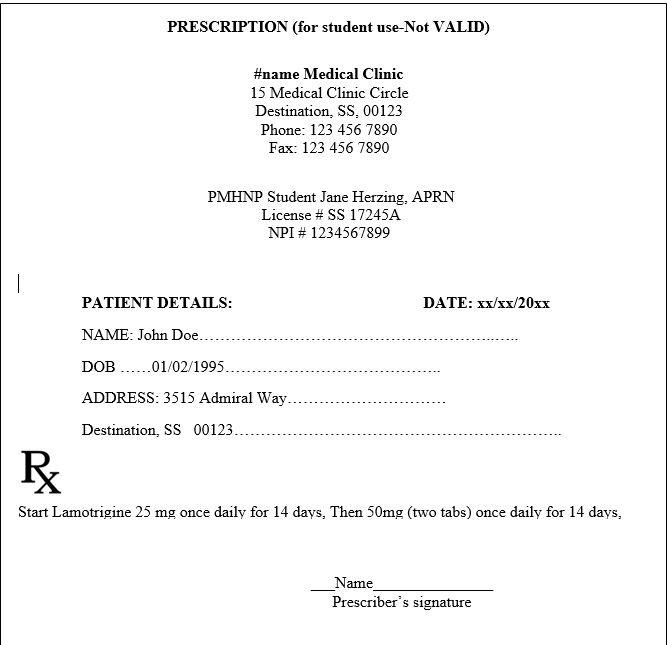
Plan to start Lamotrigine at 25 mg once daily for 2 weeks, titrate then to 50mg once daily for 2 weeks, then 100mg once daily for one week.
Plan to schedule a follow up appt with patient on or during the initiation of the 50mg schedule.
Patient to obtain creatinine level and electrolytes to ensure adequate kidney function to be able to excrete the medications from the body and to ensure the kidney can handle the medication if titration occurs.
Will educate patient to continue to keep daily record of moods and sleep patterns as this will assist to evaluate the treatment is adequate for john and achieving a good therapeutic range.
Will refer to mental health psychiatrist for confirmation of diagnosis.
Will refer to the primary care physician to evaluate the mildly elevated blood pressure. Will refer to psychotherapies such as (cognitive-behavioral therapy, family focused therapy, interpersonal and social rhythm therapy) to improve both symptoms, behavior and functioning.
Will recommend multivitamins that will include omega 3, Vitamin B, D, B12 and folate.
As these vitamins are very essential for the functioning of neurons. Study by Ravindran et al. (2016) showed the vitamins helps to improve treatment of depression and other mood disorders.
Daily exercise helps to maintain good physical and mental health. Acupuncture showed significant effective improvement after the treatment for patients with depression (Ravindran et al., 2016).
Plan to proceed to maintenance dosing of Lamotrigine 200mg daily after obtaining baseline creatinine level if symptoms and behavior improved.
The medication will be reinforced with continued outpatient counselling.
This will reinforce to explore options, develop adequate strategies for John to increase his self-esteem. Follow up is set in 2 weeks or earlier if any depressive or mood behavior occurs or worsens.
If no further improvement is noted after the four weeks or mania occurs prior to the follow up appt, will add Lithium or Olanzapine depending on the symptoms.
Case Study Psychiatric SOAP Note
Case Study Psychiatric SOAP Note
Copy any Case study questions from the instructions and answer here.
Does the patient’s history support a diagnosis of bipolar disorder even though his symptoms appear to have been triggered by a selective serotonin reuptake inhibitor?
As you continue, customnursingassignments.com has the top and most qualified writers to help with any of your assignments. All you need to do is place an order with us. (Case Study Psychiatric SOAP Note)
Case Study Psychiatric SOAP Note
Yes, the patient’s history supports a bipolar diagnosis even before his manic symptoms became ‘full blown’ after he was placed on SSRIs. Anyayo et al. (2021) mentioned that mental health experts admit that diagnosis bipolar disorder is not an easy task there aren’t lab tests to make a confirmatory diagnosis and its correct diagnosis has to rely on a combination of methods, symptoms and behaviors.
Prior to initiating patient on the SSRIs, the 26-year man was having depressive episodes impaired cognition, despondent thoughts, depressed mood and poor energy among others. For the bipolar disorder before diagnosis to have manifested- the mania phase may have presented itself as recovery from the depression phase.
This diagnosis for bipolar disorder is made after ruling out other conditions where a thyroid function test is needed to rule out hypothyroidism, hypercalcemia, or other nutritional deficiencies. To diagnose bipolar disorder the patient must have at least one depression episode and one manic or hypomanic episode after a mental health evaluation (Anyayo et al., 2021).
What would be the expected future course of illness for this patient?
Baldessarini, et al. (2020) identified in mental health evidence indicating that almost 50% of all Bipolar disorder diagnosed cases outgrow the condition between the ages of 18 and 25 years. However, since patient is already 26 years old one can expect the future course of the illness for the young man is the manic- Bipolar depression phases will continue to cause severe and unusual mood shifts and energy that significantly impact on the patients to execute his daily tasks.
Be that as it may, ongoing treatment and self-management can see the patient maintain stable moods for long periods of time.
If the patient develops another depressive episode, how would you treat it?
To treat another depressive episode, I would use lamotrigine as it reduces the risk of depressive episodes recurrences on a long term basis. Adjunct of Quetiapine or Valproate may substitute.
What medication would you choose (there could be many correct answers).
FDA has approved Lamotrigine for long term prophylaxis in BD. Other medications that could be used is lithium or even second generation antipsychotics like quetiapine, lurasidone, olanzapine – fluoxetine and carbamazepine for short term treatment of BD acute depressive episodes (Gitlin, 2018). Taking Lamotrigine, despite its mechanism of action being not adequately understood, it belongs to the triazine group meaning that it selectively binds sodium channels.
The binding then stabilizes the presynaptic neuronal membrane and therefore inhibits the release of glutamate. Lamotrigine is also believed to impact other neurotransmitters like dopamine, serotonin and norepinephrine. Another theory contends that Lamotrigine has the capacity to interact with voltage activated calcium gated channels triggering a wide range of activity.
Provide and reference a recent research article (Published over the last 3 years) on the medication treatment of Mood Disorders
Anyayo, L., Ashaba, S., Kaggwa, M.M., Maling, S. & Mpungu, E. (2021). Health-related quality of life among patients with bipolar disorder in rural southwestern Uganda: a hospital based cross sectional study. Health Qual Life Outcomes 19,84 (2021). https://doi.org/10.1186/s12955-021-01729-5
Gitlin, M. J. (2018). Antidepressants in bipolar depression: an enduring controversy. International journal of bipolar disorders, 6(1), 1-7.
Ravindran, A.V., Balneaves, L.G., Faulkner, G., Ortiz, A., McIntosh, D., Morehouse, R.L., Ravindran, L., Yatham, L.N., Kennedy, S.H., Lam, R.W., MacQueen, G.M., Milev, R.V. & Parikh, S.V. (2016). Canadian Network for Mood and Anxiety Treatments (CANMAT) 2016 Clinical Guidelines for the Management of Adults with Major Depressive Disorder: Section 5. Complementary and Alternative Medicine Treatments. Canadian Journal of Psychiatry. Sep;61(9):576-87. doi: 10.1177/0706743716660290.
customnursingassignments.com has the top and most qualified writers to help with any of your assignments. All you need to do is place an order with us.(Prescribing Assignment)
NU670-8c- Advanced Psychopharmacology and Health Promotion
Prescribing Assignment
Determine if your practice state is an independent practice state for APRNs.
Connecticut is an independent practice state, hence advance practice nurses must hold Connecticut RN licensure provided by the Connecticut Department of Public Health (AANP, n.d.). APRNs are licensed in Connecticut, and any APRN personnel cannot practice without a license. Equally, the state recognizes other nursing certifications, including practitioners, specialists, anesthetists, and midwives, though the latter has different certification processes and requirements.
Look up the APRN prescribing regulations in your state.
APRNs are licensed under Section 20-29A, maintaining their certification with the American Association of Nurse Anaesthetists, are allowed to prescribe, dispense and administer drugs, including controlled medications (Connecticut General Assembly [CGA], 2012). However, licensed APRNs under Section 20-29A who have not maintained their certification with the AANA may also prescribe, dispense and administer drugs, including controlled medications under Section 20-87A (CGA, 2012).
What are the safe prescribing recommendations for APRNs in your state? This will vary depending on the level of practice authority.
Connecticut’s Department of Public Health (DPH) provides licenses for APRNs to perform advanced nursing practices, including prescribing medications (Dube, 2009). Connecticut’s legislation requires that APRNs should work in collaboration with a licensed physician. As a result, there is a need for written documentation outlining this APRN-Physician collaboration’s precepts to enable the APRN to prescribe medication safely. The documentation details the list of medications that the APRN is allowed to prescribe.
Furthermore, the Connecticut state allows an APRN to collaborate with a physician in all settings to prescribe, dispense, and administer clinical therapeutics and other corrective measures (Dube, 2009). Besides, APRNs can request, authenticate, obtain, and distribute drug samples (Dube, 2009). Lastly, APRNs are allowed to dispense and administer medication only when he/she is presently certified by the AANA or when the attending physician is present during the surgery.
Does your state have a Prescriptions Drug Monitoring Program? If so, explain. If not, please describe current legislation regarding this topic.
Connecticut has a Prescription Drug Monitoring Program, i.e., the Connecticut Prescription Monitoring and Reporting System (CPMRS) (Connecticut’s Official State Website, n.d.). The healthcare providers and pharmacists use the CPMRS to guide them in the active treatment of patients. The program presents a comprehensive guide of substance use among patients and other providers’ prescriptions (Connecticut’s Official State Website, n.d.).
As a result, the CPMRS plays a significant role in improving patient care quality while reducing medical errors from wrong prescriptions, addiction, and overdose. Consequentially, the healthcare providers get the opportunity to manage patient treatment and referral services effectively. In this sense, the healthcare providers refer patients to drug abuse providers, including a drug overdose or addiction, in instances when appropriate.
What are the barriers to APRN’s prescribing in your state?
Like any other state, registered nurses in Connecticut experience barriers in their path to practice. One such barrier is the requirement that full practice authority I granted to nurse practitioners only when they finish a three-year practice and attain 20 000 hours of training (NursingLicensure, 2021). Furthermore, nurse practitioners, specialists, and anesthetists are required by law to pursue and graduate with a master’s degree in nursing or any other related field whose qualification can be certified (Dube, 2009).
As you continue, customnursingassignments.com has the top and most qualified writers to help with any of your assignments. All you need to do is place an order with us. (Prescribing Assignment)
Prescribing Assignment
The proponents of APRNs’ independent practice in Connecticut argue that APRNs’ proper training can effectively and independently provide primary care services proficiently and effectively (Dube, 2009). Besides, APRNs’ independent certification does affect caregivers’ earning. The Institute of medicine argues that APRNs should be allowed to practice exclusively and the comprehensive extent of their training and training (Feyereisen, & Goodrick, 2020).
What local or national organizations are available for you to join in supporting the cause for advancing practice/prescribing for APRN?
State professional organizations in Connecticut include the Connecticut Advanced Practice Registered Nurse Society, the Connecticut Board of Examiner in Nursing, and the Connecticut Association of Nurse Anaesthetists (NursingLicensure, 2021). Besides, Connecticut accepts endorsements provided by the American Nurses Credentialing Centre, American Association of Nurse Anaesthetists, and American Academy of Nurse Practitioners, Paediatric Nursing Certification Board, National Certification Corporation for the Obstetric, Gynecologic and Neonatal Nursing Specialties, Oncology Nursing Certification Corporation, and American Association of Critical-Care Nurses
References
American Association of Nurse Practitioners. (n.d.). Information and Resources for Connecticut NPs. Retrieved 2 April 2021, from https://www.aanp.org/advocacy/connecticut.
Feyereisen, S., & Goodrick, E. (2020). Examining variable nurse practitioner independence across jurisdictions: a case study of the United States. International Journal of Nursing Studies, 103633.
customnursingassignments.com has the top and most qualified writers to help with any of your assignments. All you need to do is place an order with us.(Complementary and Alternative Medicine in Mental Health Care)
Unit 7 Discussion- Complementary and Alternative Medicine in Mental Health Care
Mental illness is estimated to cause 33% of adult disability globally, with the World Health Organization reporting that only less than half of these patients receive treatment (WHO, 2017). Literature indicate that while mental ill-health is one of the leading pandemics of the 21st century, a significant number seek complementary or alternative medicine (CAM) in most countries of the world (Wembrell et al., 2020).
In contemporary mental healthcare, CAM has considered treatment options that are safe, effective, and affordable. Schulz & Hede (2018) define CAM as diagnostic techniques and treatment practices regarded as outside of mainstream and standard healthcare that include but are not limited to herbal medicine, meditation, yoga, massage, spiritual/ healing, and homeopathy. Others are like acupuncture and aromatherapy.
Diagnostic Tests and Assessments and CAM Pharmacological Interventions
Diagnostic tests and assessments used in psychiatric mental health practice regardless of the approach the practitioner will use consists of a physical exam to rule our physical issues that could trigger the patient’s symptoms, lab tests like checking the patient’s thyroid function or drug or alcohol screening, and a psychological evaluation whereupon consultation the appropriate treatment is initiated. Jones et al. (2019) observe that some of the most common lab tests used in CAM are live blood cell analysis, leukocytotxic tests (Melisa test, ALCAT test, Bryan’s test), food intolerance testing using food antigen-specific IOgG4 antibodies, and hair analysis for trace elements and minerals among others.
Once the PMNP has ruled out physical and organic causes to the mental illness, for example, depression and anxiety, one may opt to initiate a herbal medicine as the pharmacological intervention. In a study conducted by Liu et al. (2015), herbal medicine was a commonly utilized cure for a collection of mental disorders like anxiety, depression, and insomnia. The herbal concoction is believed to have therapeutic value through various mechanisms of action in different systems.
The ginseng herb is used as an antidepressant (Zanos & Gould, 2018). The researchers posit that the recommended dosage for Panax ginseng medication dosage is 75-300 mg/kg, with the water extract being administered orally at least twice a day. The MOA of ginseng as an antidepressant is up-regulating dopamine and other related neurotransmitters by suppressing their reuptake in the brain.
Doctors advise patients not to mix ginseng with a group of antidepressants categorized as monoamine oxidase inhibitors (MAOIs). This contract indication is informed by the rationale that taking MAOIs simultaneously with ginseng can lead to manic episodes and tremors.
Patient Education, Health Promotion, Maintenance, and Psychosocial Needs
The practitioner should also educate the patient on the benefits of ginseng to general and mental health. The patient’s involvement in non- pharmacological interventions like physical activities and having active hobbies like jogging or sports as health promotion activities would also help the patients meet their psychosocial needs.
As you continue, customnursingassignments.com has the top and most qualified writers to help with any of your assignments. All you need to do is place an order with us. (Complementary and Alternative Medicine in Mental Health Care)
Complementary and Alternative Medicine in Mental Health Care
In case the patient’s depressive symptoms do not lessen and instead worsen, the patient should be referred to a tertiary level hospital to get specialized treatment and hospitalization depending on the severity. The patient would be advised to return to the clinic after four weeks unless the symptoms or side effects worsen. Ginseng herb therapeutic benefits are expected to manifest in four weeks.
CAM continues to gain acceptance as a conventional approach to psychiatric-mental ill-health syndromes. Although not 100 percent effective, many CAMs interventions do alleviate human suffering by offering mental health services that are affordable and have been demonstrated to be safe and effective.
References
Jones, S. L., Campbell, B., & Hart, T. (2019). Laboratory tests commonly used in complementary and alternative medicine: a review of the evidence. Annals of clinical biochemistry, 56(3), 310-325.
Liu, L., Liu, C., Wang, Y., Wang, P., Li, Y., & Li, B. (2015). Herbal medicine for anxiety, depression, and insomnia. Current Neuropharmacology, 13(4), 481-493.
Ng, J. Y., Nazir, Z., & Nault, H. (2020). Complementary and alternative medicine recommendations for depression: a systematic review and assessment of clinical practice guidelines. BMC complementary medicine and therapies, 20(1), 1-15.
Schulz, P., & Hede, V. (2018). Alternative and complementary approaches in psychiatry: beliefs versus evidence. Dialogues in clinical neuroscience, 20(3), 207.
Wemrell, M., Olsson, A., & Landgren, K. (2020). The Use of Complementary and Alternative Medicine (CAM) in Psychiatric Units in Sweden. Issues in Mental Health Nursing, 41(10), 946-957.
customnursingassignments.com has the top and most qualified writers to help with any of your assignments. All you need to do is place an order with us.(Advanced Psychopharmacology and Health Promotion)
NU670-8C: Advanced Psychopharmacology and Health Promotion
Unit 8 Discussion-Reflection
Healthcare services providers acknowledge that the prevalence mental disorders and diseases presents a major public health issue. Significant mental diseases and conditions like depression, bipolar disorder and schizophrenia consume a major budgetary allocation of the national, state and local government besides that of insurers and the patient together with their family. The National Institute of Mental Health reports that neuropsychiatric disorders remain a major cause of disability with estimates indicating that 1 in 5 adults has some form of mental illness.
Research also indicates that the Covid- 19 pandemic has pushed the prevalence to 29 % (Winkler et al., 2020). As such, we as nurses have a central role to play in promoting the health of our clients. Most importantly, one must not lose focus of the fact that a health care personnel competence is founded on one’s education and the knowledge and skills it provides. Guided by this amongst other motivations, I enrolled in the Advanced Psychopharmacology and Health Promotion Course at Hertzing University.
The other is that the enactment of the Affordable Care Act in 2010 offers millions of Americans access to healthcare. Many of us who work in the mental health profession do support the expansion on the Mental Health Parity and Addiction Equity Act of 2008 as we endeavor to provide mental health care that is of high quality and treatment. The reflection also examines how the materials learned in this course will be applied in general psychiatry and specifically by the psychiatric nurse practitioners.
Learning Objective 1: Understand and be able to articulate the fundamentals of neurotransmission as it relates to prescribing psychotropic medications for clients with acute and chronic mental health conditions.
The topic on neuroscience with its assigned readings like Stahl’s essential psychopharmacology and memorable psychopharmacology were quite informative for me right from the beginning of the course to the very end. A host of videos that we watched and used as part of discussion like Neuroanatomy Made Ridiculously Simple to mnemonics on the stem of the brain, four lobes of the brain all the way to introduction and neurotransmitters came in handy when it comes to helping the student achieve the set objective.
The course also had requirements that necessitated one to visit websites like The Anatomy of Your Brain and Unit 1 discussion where the student is accorded the chance to interact with peers in a very engaging manner. Unit 1 assignments on synchronous learning activity, portfolio on neuroanatomy and neurotransmission chart compression sharped my research skills. Other course topics that significantly contributed to my achieving objective one was the discussion on mood stabilizers and this reflection on the same in the eighth and last unit of this course.
Learning Objective 2: Discuss major categories of psychotropic drugs, their rationale for use, mechanisms of action, common side effects, and drug interactions.
In addition to the assigned readings of Units 1, 3, 4, 6, & 8, I had the opportunity to conduct other electronic searches that yielded scholarly articles detailing the criteria and rationale used to categorize psychotropic substances like the ATC classification (Rao & Andrade, 2016). Put simply A stands for the anatomic site of action e.g. the CNS, T represents the therapeutic indication (e.g. treatment of MDD) while C refers to the chemical class of the drug (e.g. SSRIs or SNRIs).
Another is the NbN system that utilizes four supplemental dimensions past basic pharmacology like approved indications, efficacy and side effects, practical note and neurobiology. I have to admit that I found the discussion responses and initial posts on bipolar disorder treatment of mood stabilizers versus antipsychotics refreshing as they gave the divergent stands and points of views on the psychiatric nurse practitioners. The same can be said of chronic pain and the prevalence of prescription opioids addiction.
Learning Objective 3: Discuss evidence to support and the appropriate use of complementary alternative medications in patients that are experiencing acute and chronic mental health conditions seeking adjunctive or monotherapy treatment while considering cultural and genetic factors as well as patient values.
The third objective was optimally addressed by Unit 7 where we dealt with crisis management, adverse reactions, complementary and function medicine. Completing the portfolio charts and exploring the assigned case study did more than just presenting me with a simulated like clinical scenario.
As I reflect on how the course topic reinforced and enhanced the achievement of learning objective 3, it is worth noting that literature demonstrates that tranquilizer misuse is linked to alcohol and illicit drug problems and issues on mental health in university students (Grant et al, 2020). This made me reflect on the high- stress occupation that nursing is due to excessive workloads, overtime, and rotating shifts that lead to some nurses abusing drugs and alcohol.
Learning Objective 4: Utilize clinical assessment tools associated with diagnosing and prescribing for psychiatric disorders and begin to utilize these tools in clinical settings to assist with diagnosis and treatment of chronic mental health conditions.
Comprehensively going through the assigned readings on Neuroscience (1), Mood disorders and mood stabilizers(3),depression and antidepressants(4) and chronic pain and addictions(6) was instrumental in ensuring that the advanced practitioner in PMHNP rightly helps to close the existing knowledge gap and help plug the shortage of specialist nurses who have selected psychiatry as their specialty.
There was the case study of a 47 year old woman diagnosed with depression and anxiety and having comorbidities of hypertension and diabetes. The patient also had poor lifestyles as she was smoker. Devising a suitable treatment plan also sharpened my knowledge and skills in psychiatric nursing practice (Grinchii & Dremencov, 2020).
As you continue, customnursingassignments.com has the top and most qualified writers to help with any of your assignments. All you need to do is place an order with us. (Advanced Psychopharmacology and Health Promotion)
Advanced Psychopharmacology and Health Promotion
Learning Objective 5: Propose psychotherapeutic medication for selected patients keeping in mind safety concerns while utilizing knowledge of current mental health, medical concerns, age, gender, cultural factors, genetic factors, ethical concerns, patient values, and prescriptive authority impact decision making.
The successful achievement of the fifth learning objective in my considered opinion could not have been possible without a thorough understanding and masterly of at least half of the course units. While these units were namely 2, 3, 5 and 6, the limited scope of this reflexive essay makes me select Unit 2 topics of psychosis, schizophrenia and antipsychotics for further exploration.
Watching the videos on a brief introduction to psychosis, antipsychotics, schizophrenia simulation and the one on schizophrenia: causes, symptoms, diagnosis, treatment and pathology left a mark in me in a major way. By watching the videos, I believe I can adequately propose psychotherapeutic medication for the patients in contexts.
Suffice it to say that the selection of the best drug to use would be informed by several other factors that include age, gender, ethical concerns, genetic factors, cultural factors and patient values (Soltis- Jarrett, 2020). Other factors that would also dictate the clinical decision that I make are the prescriptive authority of the state where I practice in so that my patients receive evidence based treatment that is patient focused.
Learning Objective 6: Utilize research and provide basic diagnostic and psychopharmacology education to your client and his/her family when prescribing.
According to Sarikhani et al (2020) the use of existing research findings in the provision of fundamental diagnostic and psychopharmacological education provides constitutes the backbone of evidence based treatment and practice in nursing. Therefore almost all of the course units had a component that required the student to incorporate current research findings relevant to the case in context.
The nurse practitioner is reminded that patient education addressing their condition or illness holds the key to better patient outcomes and improved quality of life.
Learning Objective 7: Understand ethical and legal considerations and controversies in the current pharmacological treatment of mental health patients
The centrality of ethics in psychiatric research and the legal considerations that a psychiatric specialist nurse is underpinned by the fact that of the eight units only units 1, 3 and 4 did not explicitly address ethics in their design. As Shobhit et al (2017) note several issues relating to psychiatric disorders call for the protection of rights of persons with mental illness.
For example cultural psychiatrists use explanatory models of illness like the moral model, psychosocial stress model, magical/supernatural model, religious model, and medical model to account for variations in beliefs on causation of psychiatric disorders. While doing the assignment on complementary and alternative medicine, the issue of ethics was paramount as the practitioner has got to factor in the ethics of prescribing say ginseng herbal medicine for depression.
If it the patient’s preference, the practitioner has a responsibility of highlighting the benefits and drawbacks of herbal medicine use so that the patient makes an informed decision.
How the Materials Learned in this Course will be Applicable in PMHNP Practice
In general terms, the contents of the course are bound to have ready application in the field of the science of psychiatry and psychiatry practice. This is because all nurses are trained and taught right from their introductory courses of nursing education that for nursing practice to be relevant and beneficial to the patient it has to be holistic and individual- centered. Subsequently, the care offered must at all times be designed in ways that meet the biological, psychological, social, and spiritual needs of the those seeking nursing and healthcare services. Most importantly, the advance practice registered who has selected psychiatric mental health regard the patient as whole being whose needs must be addressed at all levels.
As you continue, customnursingassignments.com has the top and most qualified writers to help with any of your assignments. All you need to do is place an order with us. (Advanced Psychopharmacology and Health Promotion)
Advanced Psychopharmacology and Health Promotion
Conclusion
As I bring my reflection on Advanced Psychopharmacology and Health Promotion course to a conclusion, I cannot help but settle on the contemporary movement dubbed Whole Health Care or Behavioral Health Integration in addressing the psychological, behavioral and physical health care needs of my patients. As PMHNPs we must be prepared to not only offer independent and autonomous mental health care but also be ready to work in interprofessional health care team headed by a psychiatrist. Doing so would allow psychiatrists more time to devote to patients presenting with more complex cases and higher acuity and therefore improve the delivery of quality treatment that is patient-based in the care continuum.
References
Grant, J. E., Lust, K., & Chamberlain, S. R. (2019). Sedative/Tranquilizer Misuse is Associated with Alcohol and Illicit Drug Problems, Mental Health Issues, and Impulsivity and Compulsivity in University Students. Journal of addiction medicine, 14(3), 199.
Grinchii, D., & Dremencov, E. (2020). Mechanism of Action of Atypical Antipsychotic Drugs in Mood Disorders. International Journal of Molecular Sciences, 21(24), 9532.
Jain, S., Kuppili, P. P., Pattanayak, R. D., & Sagar, R. (2017). Ethics in psychiatric research: issues and recommendations. Indian journal of psychological medicine, 39(5), 558-565.
Rao, T. S., & Andrade, C. (2016). Classification of psychotropic drugs: Problems, solutions, and more problems. Indian journal of psychiatry, 58(2), 111.
Sarikhani, Y., Bastani, P., Rafiee, M., Kavosi, Z., & Ravangard, R. (2020). Key barriers to the provision and utilization of mental health services in low-and middle-income countries: a scope study. Community mental health journal, 1-17.
As you continue, customnursingassignments.com has the top and most qualified writers to help with any of your assignments. All you need to do is place an order with us. (Advanced Psychopharmacology and Health Promotion)
Advanced Psychopharmacology and Health Promotion
Soltis-Jarrett, V. (2020). Integrating behavioral health and substance use models for advanced PMHN practice in primary care: Progress made in the 21st century. Archives of Psychiatric Nursing, 34(5), 363-369.
Winkler, P., Formanek, T., Mlada, K., Kagstrom, A., Mohrova, Z., Mohr, P., & Csemy, L. (2020). Increase in prevalence of current mental disorders in the context of COVID-19: analysis of repeated nationwide cross-sectional surveys. Epidemiology and psychiatric sciences, 29.